How to Improve Your Concentration While Studying: What Actually Works, According to Science and Practice
We've all been there: you're sitting at your desk, the book is open, but after ten minutes your mind starts to wander. To your phone, to the window, to anything other than the material you're supposed to be studying. You read a paragraph three times without actually absorbing it. By the end of the afternoon, you've spent three hours at your desk but maybe only studied effectively for 45 minutes.
Concentration problems while studying are the most common obstacle that students mention when it comes to their academic performance. And the problem isn't getting any smaller. In a world where the average person picks up their smartphone every twelve minutes and notifications arrive by the second, focused work has become a real challenge.
But concentration isn't an innate trait you either have or don't. It's a skill that can be trained and supported through the right conditions. In this article, you'll learn why concentration while studying is so difficult, which methods are scientifically proven, and how you can deliberately improve your focus.
Why Is Concentration While Studying So Difficult?
To improve your concentration, it helps to first understand why it's so easily lost.
The human brain isn't designed to stay focused on a single task for hours on end. From an evolutionary perspective, it was essential for survival to constantly scan the environment and react to new stimuli. Deep concentration on an abstract task — like learning mathematics or reading a technical text — is, from evolution's standpoint, an unnatural demand.
On top of that, there's the modern stimulus environment. Smartphones, social media, and constant connectivity have made the problem worse. A study from the University of California, Irvine, showed that after an interruption, it takes an average of 23 minutes to regain the same level of focus you had before the disruption. So if you check your phone three times per hour, you're effectively spending most of that hour trying to refocus rather than actually studying.
The type of study material also plays a role. Tasks that are too easy bore the brain and cause it to drift. Tasks that are too difficult overwhelm it and create frustration, which also leads to a loss of concentration. The optimal state, which psychology calls flow, occurs when a task sits right at the boundary between your ability and the challenge. This state is rarely achieved in school learning, however, because the material is often either too standardized or too far removed from the individual's level.
Sleep deprivation, nutrition, and exercise are additional factors that directly affect concentration. A student who slept six hours, had a bag of chips for breakfast, and hasn't been outside since morning is neurobiologically worse equipped for focused studying than someone who is well-rested, well-nourished, and physically active.
The Pomodoro Technique: Focused Studying in Intervals
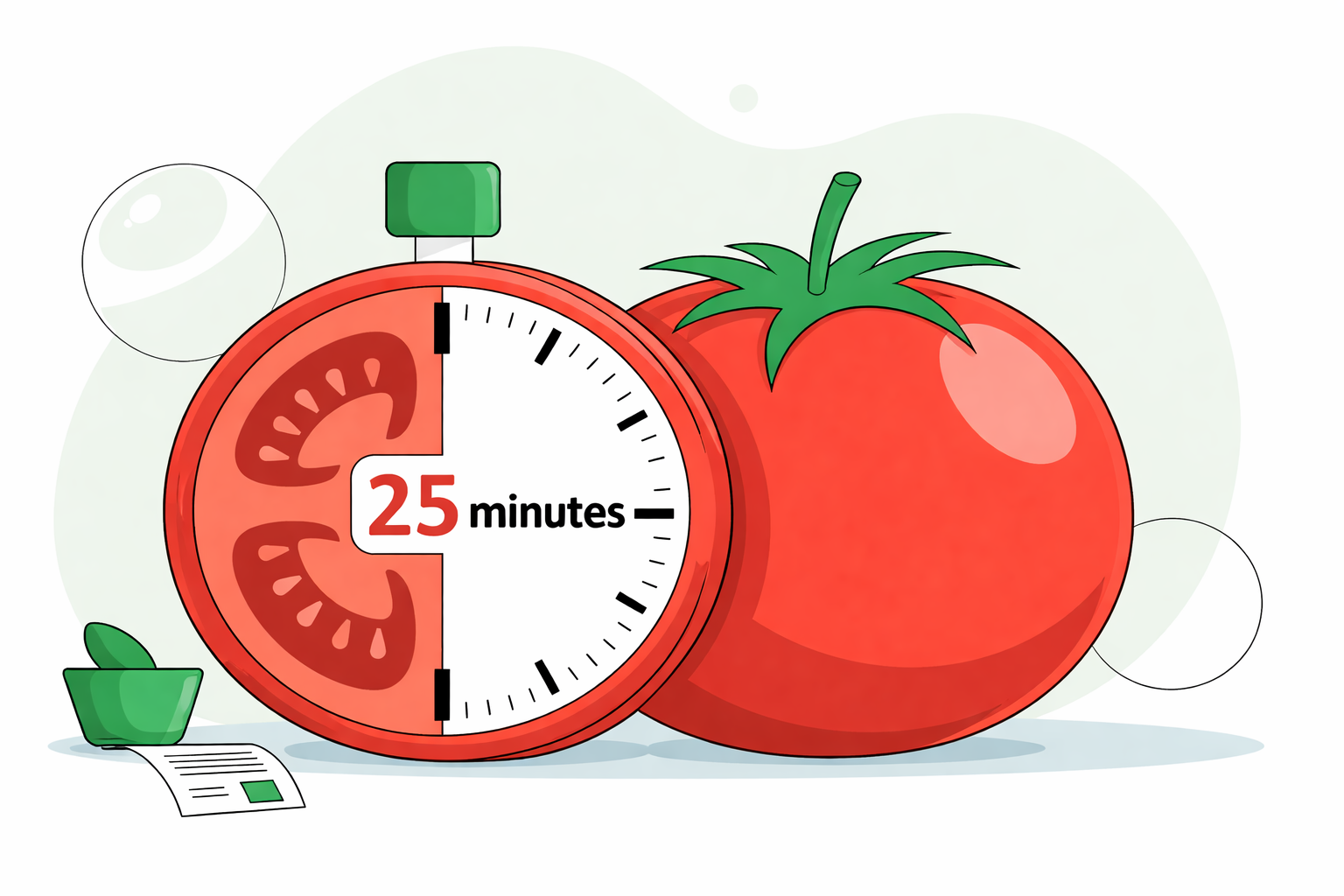
The most well-known method for improving concentration while studying is arguably the Pomodoro Technique, developed by Francesco Cirillo in the 1980s.
The principle is simple: you work for 25 minutes with full focus on a single task, without any interruption. Then you take a five-minute break. After four such cycles, you take a longer break of 15 to 30 minutes. A timer — whether on your phone or a physical clock — structures the intervals.
Why does it work? 25 minutes is short enough for the brain to engage without feeling overwhelmed. The fixed structure reduces decision fatigue: you don't have to think about when to take a break, when to keep working, or how much longer you need to push through. The timer signal makes those decisions for you.
Research shows that distributed work in blocks with breaks is more effective than working without interruption. The brain consolidates information during rest periods. Those who study without breaks don't learn more — they learn less, because the capacity for absorption decreases over time and the error rate increases.
For some students, 25 minutes may be too short or too long. Experiment with the duration: 30, 40, or 50 minutes might work better for certain tasks. What matters isn't the exact number of minutes, but the principle: focused work, clear breaks, consistent rhythm.
Your Phone: The Biggest Enemy of Concentration
There's no way around it: the smartphone is the biggest obstacle to focused studying for most students. And not just when it rings or vibrates.
A 2017 study from the University of Texas showed that the mere presence of a smartphone on the desk measurably reduces cognitive performance — even when it's turned off and placed face down. The brain uses part of its capacity to resist the temptation of reaching for the phone. That capacity is then unavailable for studying.
The solution is radical but effective: put your phone in another room during study sessions. Not on silent, not flipped over — physically out of reach. If you need it for a timer or music, use a separate clock or a laptop that doesn't have social media apps installed.
Notifications are another disruptive factor that should be eliminated. Every single notification, no matter how brief, interrupts the flow of concentration and requires time to re-engage. Most notifications aren't urgent. They can wait. Turn on Do Not Disturb mode or disable notifications for all apps except calls and messages from your closest contacts.
Optimizing Your Study Environment: Small Changes, Big Impact
Your physical study space has a direct influence on your ability to concentrate. Research in environmental psychology shows that certain factors measurably affect cognitive performance.
A tidy workspace reduces visual distraction. A clean desk with only the materials you currently need helps the brain focus on the task at hand. Clutter and visual stimuli — a stack of unopened mail, open snacks, or clothes lying around — unconsciously capture attention.
Lighting plays an underestimated role. Natural daylight is ideal. Studies show that work performance and attention are higher with daylight than with artificial lighting. If daylight isn't available, use a bright, cool-white desk lamp rather than warm, dimmed lighting.
Temperature affects concentration. A slightly cool room — around 20°C (68°F) — is more conducive to focused work than an overheated room. Too warm makes you tired; too cold is distracting.
Background noise is a matter of personal preference. Some people concentrate better in absolute silence; others need background sounds. If you prefer background noise, consistent sounds like white noise or instrumental music are better than music with lyrics, since speech activates the language processing centers of the brain and thus competes with the study material.

Sleep, Nutrition, and Exercise: The Underestimated Concentration Factors
It may sound obvious, but the three most important factors for concentration have nothing to do with study techniques. They are sleep, nutrition, and exercise.
Sleep is the single most important factor. Teenagers need eight to ten hours of sleep per night but, according to studies, get only six to seven on average. The effect on concentration is massive: sleep deprivation impairs working memory capacity, decision-making ability, and the ability to sustain attention. Sleeping one extra hour often makes the waking hours more productive than using that hour to study.

Nutrition directly affects cognitive performance. The brain uses about 20 percent of the body's total energy, despite making up only two percent of body weight. Complex carbohydrates like whole grains, nuts, and fruit provide steady energy over longer periods. Sugar and white flour create a quick energy spike followed by a performance crash. Water is equally crucial: even mild dehydration measurably reduces cognitive performance. You should aim for at least two liters of water per day.
Exercise boosts concentration immediately and sustainably. Studies show that just 20 minutes of moderate exercise — a walk, light jogging, or cycling — significantly improves attention for the following one to two hours. This is because exercise increases blood flow to the brain and stimulates the release of BDNF (Brain-Derived Neurotrophic Factor), a protein that promotes neural plasticity and thus the ability to learn.
A practical tip: build a short exercise session into your routine before studying. Twenty minutes outdoors before a study session can noticeably improve the quality of the following hour.
Multitasking: The Productivity Myth
Many students believe they can study while simultaneously listening to music, answering messages, or switching between different tasks. Research clearly disagrees.
True multitasking — the simultaneous execution of two cognitively demanding tasks — is neurologically impossible. What's perceived as multitasking is actually task-switching: the brain rapidly switches back and forth between tasks. Each switch costs time and cognitive capacity. Studies show that task-switching can reduce productivity by up to 40 percent.
Switching between studying and social media is particularly harmful. The algorithmically optimized content on Instagram, TikTok, or YouTube is designed to capture attention. Once you glance at the feed, it takes considerably more than the intended minute to become re-engaged with the study material.
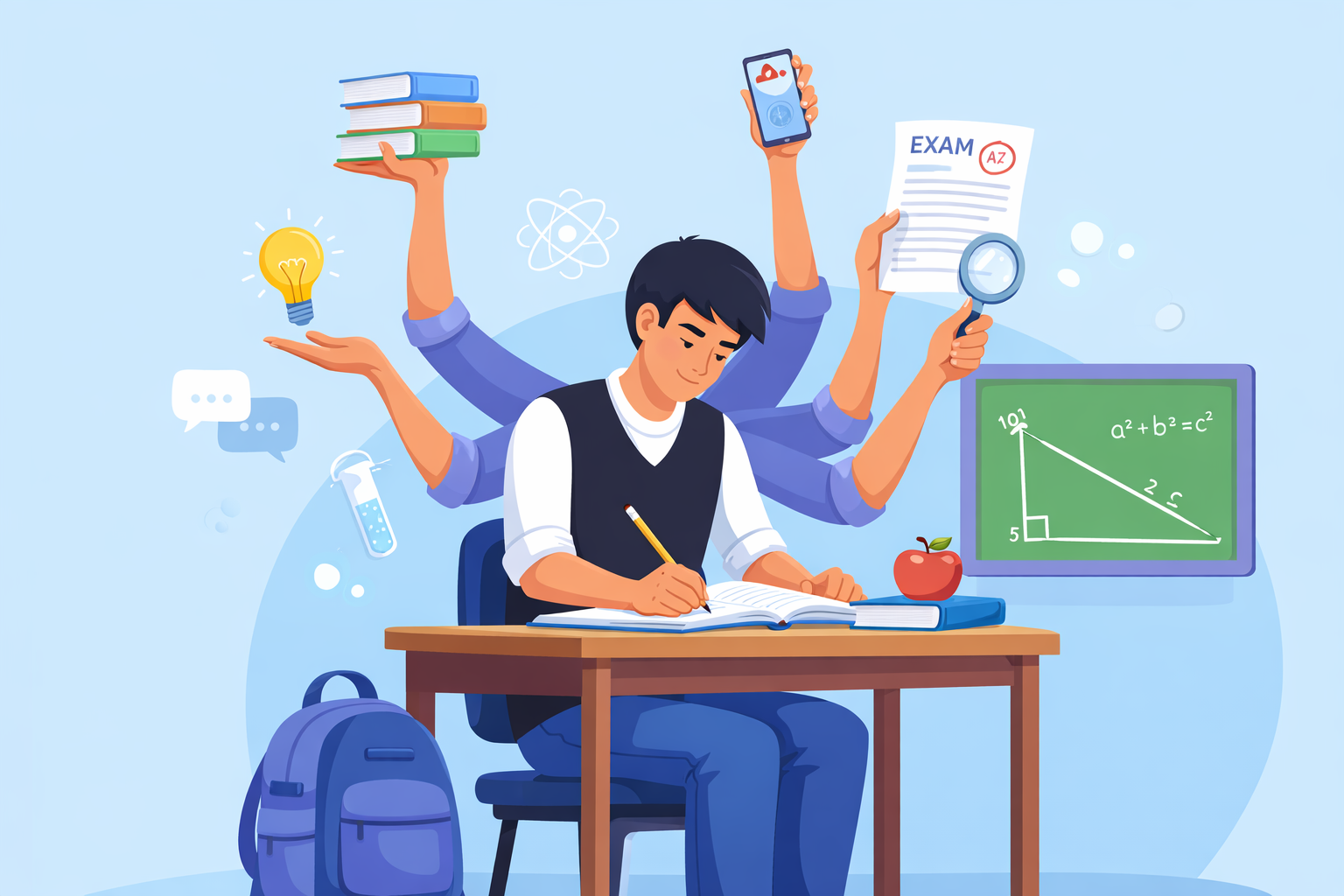
The solution is single-tasking: one task, one time block, no interruptions. This may feel unfamiliar and perhaps even boring at first. But it's precisely in that boredom where real learning happens. Your brain needs undivided attention to truly process new information, make connections, and store it in long-term memory.
Active Learning Instead of Passive Consumption: Concentration Through Engagement
An often overlooked reason for concentration problems is the passivity of the learning process. If you only read, highlight, and summarize, you're giving your brain little reason to stay truly engaged. Passive methods create the illusion of learning without deep processing actually taking place.
Active learning methods challenge the brain and maintain concentration simply by requiring engagement. Testing yourself, explaining material out loud, solving practice problems, formulating questions — all of this forces your brain to work actively rather than consume passively. And active work is focused work, because you immediately notice when your mind wanders.
The Feynman Method is a great example: take a topic you want to learn and explain it out loud as if you were explaining it to a ten-year-old. Where you stumble, you have a knowledge gap. This method doesn't just keep you focused — it also shows you where you still need to work.
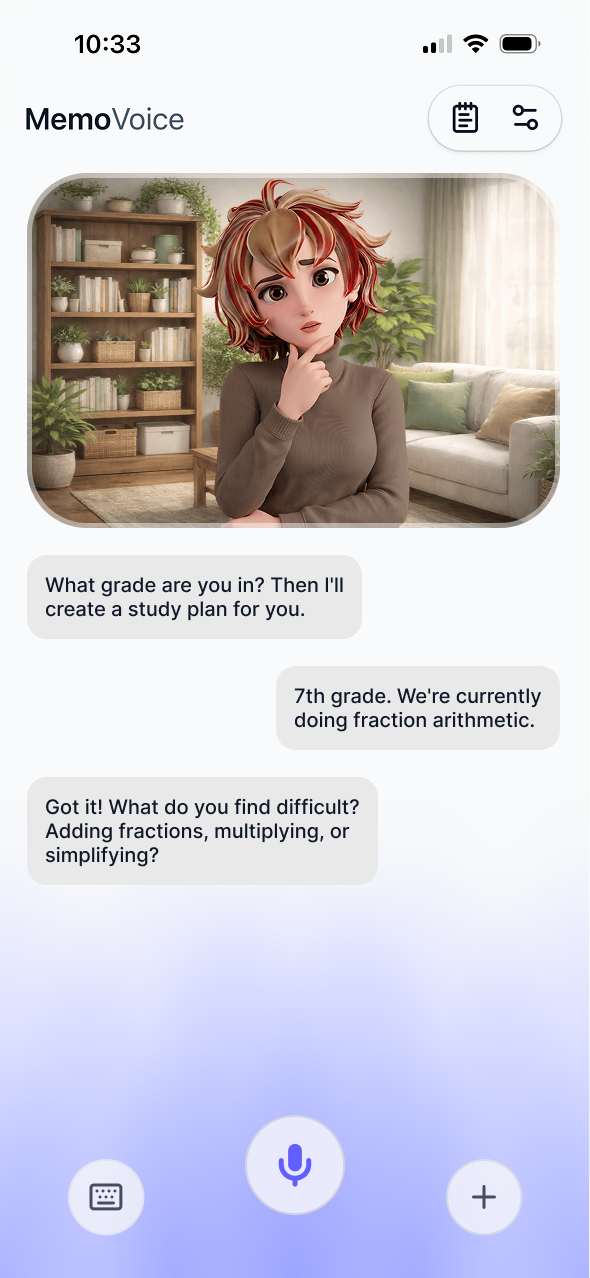
For students who struggle with passive learning and find it hard to motivate themselves on their own, an AI tutor like Memora offers a structural advantage: the real-time voice interaction makes passive consumption impossible. You have to actively speak, respond, and work on the interactive whiteboard. The system asks questions, waits for your answer, and follows up when you're unsure. This active interaction maintains concentration because you simply can't zone out without it being noticed.
Training Concentration Long-Term: Habits Over Willpower
A common misconception: concentration isn't a matter of willpower. Anyone who tries to force themselves to study for hours through sheer discipline will fail, because willpower is a limited resource that depletes throughout the day.
The more sustainable approach is to support concentration through habits and routines that minimize the need for willpower.
Fixed study times are the most effective lever. When you study at the same time and in the same place every day, your brain adapts to it. After a few weeks, getting into focus becomes easier because your body associates the situation with studying. It's like sleep: someone who goes to bed at the same time every night falls asleep more easily than someone who tries to fall asleep at a different time each night.
A pre-study ritual can ease the transition. It can be as simple as: tidy the desk, set out water, start the timer. The consistent sequence signals to the brain: now it's time to study.
Start small. If you can currently barely concentrate for ten minutes at a stretch, the goal isn't an hour right away. Start with 15 minutes of focused work and increase gradually over weeks. Concentration is a muscle. You train it step by step, not through a single feat of strength.
Meditation and mindfulness exercises are increasingly recommended in learning research as methods for improving concentration. Even five minutes of breathing exercises before studying can help clear the mind and sharpen focus. In the long term, mindfulness practices strengthen the ability to notice distractions and consciously let them go rather than automatically following them.
What If Nothing Helps? When Concentration Problems Are a Bigger Issue
In most cases, concentration problems while studying can be significantly improved through the methods described above. But not always.
If you suffer from severe, persistent concentration problems despite getting enough sleep, eating well, exercising, and optimizing your study environment, it may be worth speaking with a professional. ADHD (Attention Deficit Hyperactivity Disorder) is underdiagnosed, especially in girls and young women. The symptoms are frequently mistaken for laziness or lack of discipline, even though it is a neurobiological condition that requires targeted support.
Chronic stress, anxiety disorders, or depressive episodes can also severely impair concentration. If you feel that your concentration problems go beyond normal fluctuations, talk to your family doctor, a school psychologist, or a counseling service. It's not a sign of weakness — it's a sign of self-awareness.
Conclusion: Improving Concentration Is Achievable — With the Right Conditions
Concentration while studying isn't a matter of talent or discipline. It's the result of the right conditions: a low-stimulus environment, structured study times, sufficient sleep, exercise before studying, your phone in another room, and active rather than passive learning methods.
The Pomodoro Technique, single-tasking, and fixed study routines are simple tools that work immediately. In the long term, you train your ability to concentrate through regular practice — not through willpower.
And if you find it hard to stay focused on your own, a structured study partner can help. An AI tutor like Memora keeps you concentrated through active voice interaction and guided exercises, adapts the pace to your level, and ensures that every minute of study time is actually put to use. No passive consumption — just active learning that challenges and supports your brain, available anytime, without appointments or waiting.
The best news: concentration can be improved. Not overnight, but step by step. Start changing one habit today, and you'll notice the difference.