What Type of Learner Am I? What Research Really Says and How You Can Study Better
Visual, auditory, communicative, kinesthetic. Almost every student has heard these terms before. The idea is appealing: find out what type of learner you are, study accordingly, and everything becomes easier. There are hundreds of free learning style quizzes online that will tell you in five minutes whether you're a visual or auditory learner.
But is any of that actually true? Are there really fixed learning types? And if so, what does that mean for your studying?
The answer is more nuanced than most blog posts on this topic suggest. In this article, we'll explain where the learning types model comes from, what current research says about it, and most importantly, how you can actually use this knowledge to study more effectively.
The Four Learning Types According to Vester: The Classic Model
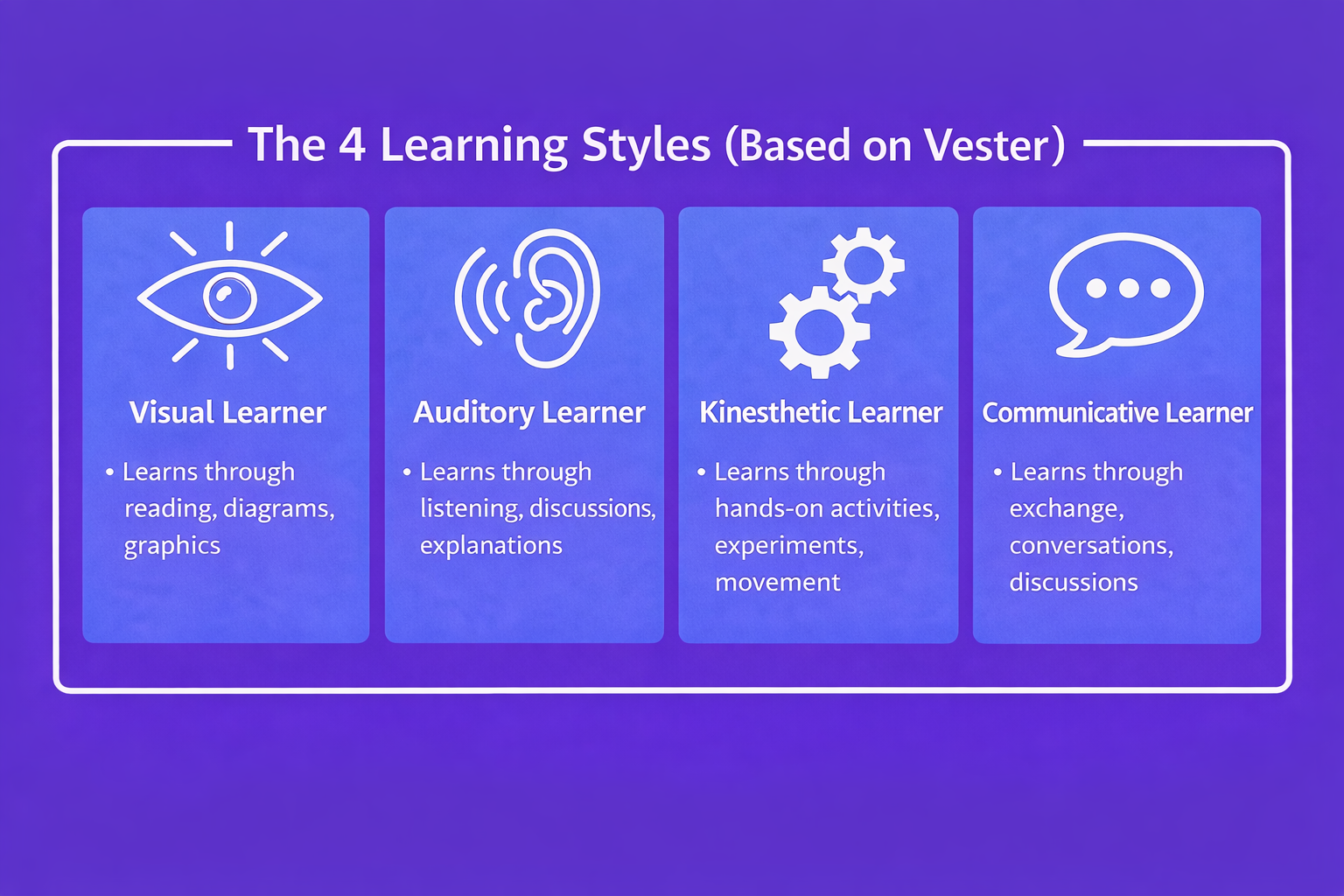
The most well-known learning types model in the German-speaking world goes back to university professor Frederic Vester, who distinguished four fundamental learning types in the 1970s.
The visual learner learns best through the eyes. Images, graphics, diagrams, colors, and written text are their preferred channels. They like taking notes, working with mind maps, and need a tidy desk to concentrate. Flashcards, color-coded highlighting, and sketches are typical tools for this type.
The auditory learner absorbs information best through listening. Lectures, explanations, podcasts, and audiobooks are their strength. They often move their lips while reading and benefit from reciting material out loud. The Feynman Method — where you explain a concept as if you were teaching it to a child — works particularly well for this type.
The communicative learner learns through conversations and discussions. They need interaction with others to truly understand content. Study groups, collaborative problem-solving, and explaining material to classmates are their path to understanding.
The kinesthetic learner learns through doing and touching. They need to try things out, conduct experiments, or integrate movement into the learning process. Sitting still and reading is difficult for them. Hands-on exercises, role-playing, and handwriting come naturally.
Most people aren't pure types but rather a mix with a tendency toward one or two directions. The model offers a starting point for recognizing your own preferences when it comes to studying.
What Research Really Says: The Learning Types Myth
This is where things get interesting, because science has arrived at a clear conclusion in recent years — one that surprises many: there is very little solid evidence that studying according to your learning type actually leads to better results.
One of the most comprehensive reviews comes from Pashler, McDaniel, Rohrer, and Bjork in 2008. They analyzed all available research and concluded that the learning styles hypothesis — the assumption that students learn better when instruction is tailored to their learning type — is not sufficiently supported. Studies that were supposed to back this claim had methodological flaws. And well-controlled studies found no significant effect.
This doesn't mean that people don't have learning preferences. Of course some prefer images, others prefer discussions, and still others prefer hands-on activities. But a preference for a method doesn't automatically mean that method is also the most effective.
An example: a student who identifies as an auditory learner may prefer podcasts over textbooks. But if they don't actively test themselves afterward on whether they can reproduce the content, they still learn less than someone who reads the material and then quizzes themselves on it. The method of retrieval beats the method of passive consumption — regardless of learning type.
Why the Concept Is Still Useful
Does this mean learning types are completely useless? No. But their usefulness lies somewhere different than most people think.
Engaging with learning types has a valuable side effect: it makes you think about your own learning. You ask yourself what helps you and what doesn't. You try out different methods instead of always just reading and highlighting. And that — the conscious examination of your own learning process — is demonstrably one of the strongest levers for better learning.
Research clearly shows: it's not the individual learning type that matters, but the variety of methods. The more senses you engage while studying, the better. Someone who reads material, then explains it out loud, then draws a sketch, and finally solves practice problems retains it far more reliably than someone who uses only one of these methods. Multimodal learning — engaging different channels — is more effective than fixating on a single channel.
That's good news, because it means you don't have to put yourself in a box. Instead of saying "I'm visual, so I only learn with images," you can say "I use images, explanations, discussions, and exercises — depending on what the material needs right now."
Which Learning Methods Actually Work — Regardless of Learning Type?
If it's not the learning type that determines success, then what? Learning research over the past few decades has identified several methods that are proven to work regardless of individual preferences.
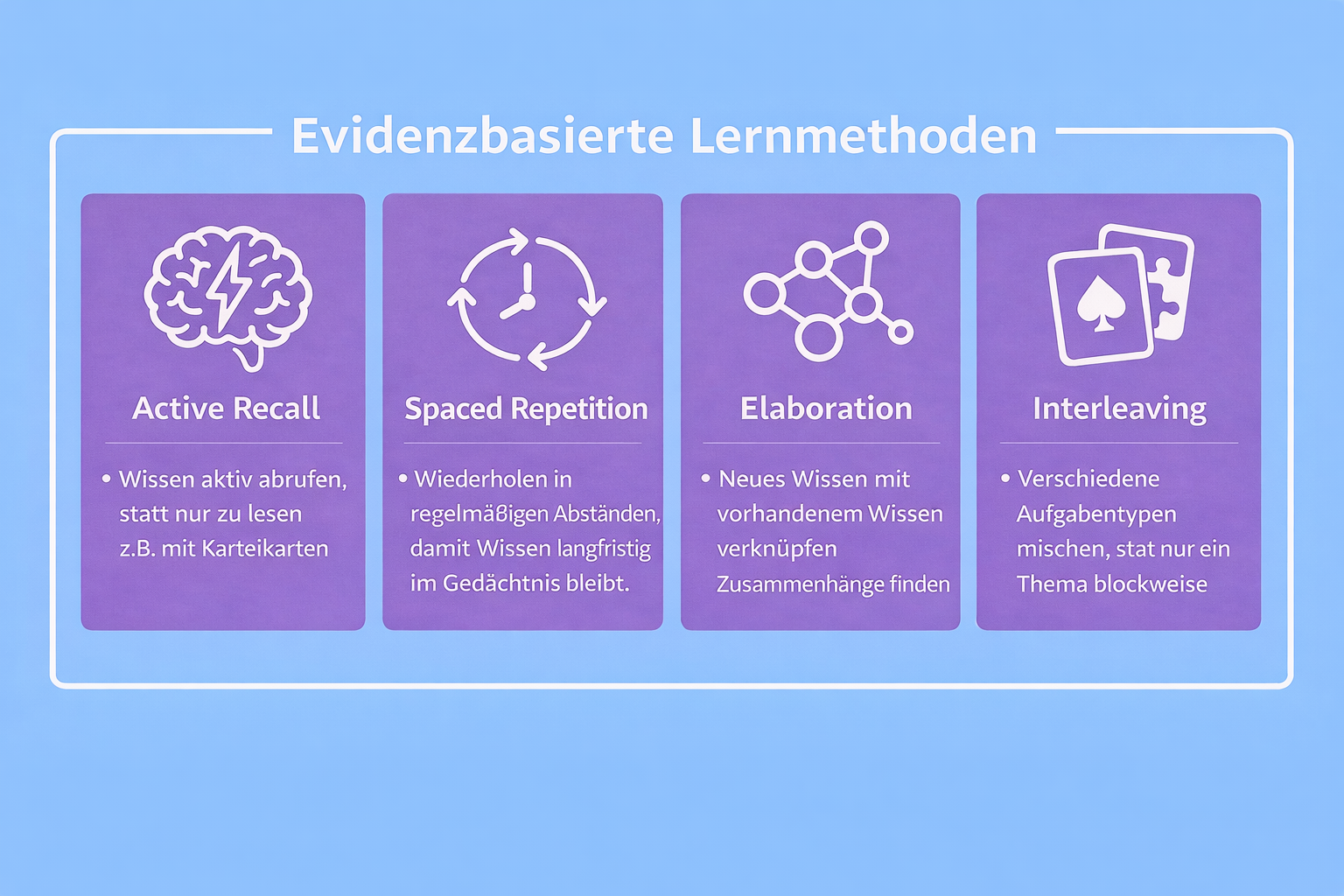
Active recall is the single most effective method. Instead of just reading or listening to material, you force your brain to reproduce it without any aids. Flashcards, self-tests, solving problems, explaining out loud — every successful retrieval strengthens the memory trace. This applies equally to visual, auditory, and all other learning types.
Spaced repetition — distributed review at increasing intervals — enormously amplifies the effect of active recall. Instead of learning everything in one sitting, you review after one day, after three days, after a week. Each repetition anchors the knowledge deeper in long-term memory.
Elaboration means connecting new knowledge with existing knowledge. Why does this formula work the way it does? How does this historical event relate to what I learned last week? The more connections you make, the more stable and retrievable the knowledge becomes.
Interleaving — alternating between different types of problems rather than working through one topic in blocks — trains your brain to recognize and select the right solution strategy. It's more demanding, but leads to significantly better transfer to new problems.
These four methods work for everyone, regardless of whether you identify as visual, auditory, or kinesthetic. They are the core of effective learning.
How to Combine Learning Types with Evidence-Based Methods
The pragmatic approach is to use both: your personal preferences as a starting point and scientifically proven methods as the foundation.
If you're visually inclined, create mind maps and diagrams as overviews — but then actively test yourself on whether you can reproduce the content without the mind map. Use colors and sketches to ease into a topic, but don't rely on looking at the sketch being enough.
If you're auditorily inclined, explain material out loud or record your explanations and listen back to them. But supplement this with self-tests and written recall so the knowledge is also accessible under exam conditions.
If you're communicatively inclined, study in groups and discuss concepts. But make sure you can also test yourself alone afterward to confirm you truly know the material — because in an exam, you're on your own.
If you're kinesthetically inclined, work by hand, use physical flashcards, and integrate movement into your study breaks. But here too, build in active recall and spaced repetition.
The combination of personal preference and proven methodology is the key. Your preferences make studying more enjoyable and lower the barrier to getting started. The scientific methods ensure the knowledge actually sticks.
Why Personalized Learning Matters More Than Learning Types
The real insight behind the learning types debate is this: everyone learns differently — not because of a fixed type, but because everyone has a different level of knowledge, different gaps, different strengths, and a different pace.
Personalization in learning doesn't mean a visual learner only sees images. It means the learning process adapts to your current level, starts where your gaps are, and chooses the explanation that works for you. That's exactly what a good human tutor does: within minutes, they recognize how to best reach a student and adjust their approach — not because the student is a visual type, but because this particular explanation for this particular concept works for this particular student right now.
AI-powered learning solutions like Memora take the same approach. The AI tutor uses long-term memory to track which explanatory approaches work for you, where your typical mistakes lie, and how quickly you absorb new concepts. It doesn't just adapt the channel to your learning type — it adapts the entire learning process to you as a person: difficulty level, depth of explanation, exercise intensity, and review frequency.
That's the real personalization that goes beyond learning types. Not the question "Are you visual or auditory?" but the question "What do you need right now to understand and apply this specific concept?"
Conclusion: Forget the Labels, Use Everything
Learning types are a useful conversation starter, but not a scientific law. Research clearly shows there is no evidence that studying according to your type leads to better outcomes. What actually works is methodological variety: active recall, spaced repetition, connecting to prior knowledge, and varied practice.
Use your preferences as a starting point, but don't rely on them alone. A visual learner who only draws mind maps and never tests themselves learns less than an auditory learner who explains their material out loud and then quizzes themselves with flashcards. It's not the channel that matters — it's the method.
If you take away just one thing from this article, let it be this: stop categorizing yourself as a learning type and then using only one method. Start combining different channels and, above all, regularly testing yourself. That's when you learn best — no matter what type you are.